
JORDYN HRENYK
INDIGENOUS ENTREPRENEURSHIP RESEARCH | MAKING BUSINESS WORK IN OUR WAYS
Biography

Dr. Jordyn Hrenyk is an Assistant Professor at the Gustavson School of Business at the University of Victoria. She completed her PhD in the area of Business and Society at the Beedie School of Business at Simon Fraser University (SFU). Her research is focused on Indigenous self-employment and values-aligned entrepreneurship, and she specifically studies how Indigenous entrepreneurs develop and enact shared values through their organizations.
Before graduate school, Jordyn worked with leading Indigenous entrepreneurs in a variety of industries including media, technology and education, to refine their business models and seek business funding.
Jordyn is Michif and she is a member of Métis Nation Saskatchewan, Local #7. While she was born on her home territory in Treaty 6, she is grateful to live in the traditional territories of the Lekwungen-speaking Peoples of the Songhees and Esquimalt First Nations.
-
Assistant Professor at Gustavson School of Business, University of Victoria (Jan 2026 - Present)
Provost’s Postdoctoral Research Fellow at Rotman School of Management, University of Toronto (Sep 2024 - Nov 2025)
-
PhD in Business Administration at the Beedie School of Business, Simon Fraser University
Master of Science in Management (Strategy) at the Smith School of Business, Queen’s University
Bachelor of Commerce at the Gustavson School of Business, University of Victoria
-
GATE (Institute for Gender and the Economy) Research Grant: Internal Rotman School of Management research grant ($10,000)
Irving K. Barber Foundation BC Indigenous Award: Provincial competition ($20,000, multi-year award)
SSHRC Joseph-Armand Bombardier Canada Graduate Scholarship: Doctoral student scholarship ($105,000, multi-year award)
ASAC Outstanding Reviewer Award: Case division
British Columbia Graduate Scholarship: Provincial competition ($30,000, multi-year award)
SFU Provost Prize of Distinction: Institutional competition ($5,000)
-
Producer | Animikii Indigenous Technology |2016-2018
Managed community and client relations with Indigenous for-profit, non-profit, and charitable organizations
Prepared annual social impact reports
Co-founded Songhees Innovation Centre
UN PRME: Decolonizing the Business School
In 2021, I was invited to discuss opportunities to decolonize the business school with an international audience of UN PRME (Principles of Responsible Management Education) members, fellows, and advocates. In our recorded discussion, my PhD Advisor, Dr. Dara Kelly-Roy and I outline a pathway towards decolonization in the business school. I was then invited to participate as an Editorial Board Member for the UN PRME blog, and to contribute an article on a related topic.
Research
Initially, I pursued graduate education because, in my work in industry and in the university, I realized that there was something vital missing in the way we talked about and taught Indigenous business. Specifically, I felt that too often Indigenous business leaders were being encouraged to adopt western conceptions of value when it comes to designing and growing their firms. In part because of this, I have pursued research to better understand and to explain how Indigenous business leaders contribute to Indigenous sovereignty and to community wellness when working within Indigenous values systems.
Overall, my main research interests are: strategic Indigenous entrepreneurship, Indigenous research methodologies, and decolonizing the business school. I work with entrepreneurship theories and perspectives, such as effectuation and entrepreneurial bricolage and theoretical perspectives on Indigenous business values, while also drawing from broader areas of strategic management and organization theory. All of my research is conducted with Indigenous research methodologies, and I seek to generate rigorous research findings that make a positive difference both theoretically and in practice.
-
Published and Forthcoming
Hrenyk, Jordyn. (Forthcoming). “Data Mining in Indigenous Virtual Communities: The Case for Indigenous Internet Research Protocols.” Accepted for forthcoming edited volume. Eds.: Jeffrey Ansloos, Ashley Caranto Morford, and Dave Gaertner.
Hrenyk, J., & Salmon, E. (2024). The Unstated Ontology of the Business Case Study: Listening for Indigenous Voices in Business School Curricula. Academy of Management Learning & Education, 23(4), 529–553. https://doi.org/10.5465/amle.2023.0103.
Duran, S., Hrenyk, J., Sahinyazan, F. G., & Salmon, E. (2024). Re-righting renewable energy research with Indigenous communities in Canada. Journal of Cleaner Production, 445. https://doi.org/10.1016/j.jclepro.2024.141264.
Hrenyk, J., Szymanski, M., Kar, A. and Fitzsimmons, S.R. (2016), "Understanding Multicultural Individuals as Ethical Global Leaders", Advances in Global Leadership (Advances in Global Leadership, Vol. 9), Emerald Group Publishing Limited, Leeds, pp. 57-78. https://doi.org/10.1108/S1535-120320160000009004.
Hrenyk, Jordyn and Rebecca Grant. 2016. “An Exploration of Crowdfunding on Kickstarter Canada.” Journal of Strategic Innovation & Sustainability 11 (2): 38-58.
Work in Progress
Hrenyk, Jordyn and Kam Phung. “The Ritualized Stigmaization of Seal Hunting in Canada.” (Theoretical development stage).
Hrenyk, Jordyn. “Supplanting the Core: Indigenous Beading Analysis as Arts-Based Research”. (Theoretical development stage).
Hrenyk, Jordyn and Emily Salmon. “Ethical Use of Secondary Data in Indigenous Management Research”. (Conceptual development stage).
Salmon, Emily and Jordyn Hrenyk. “Knitting Matrilineal Lines: Understanding the Economic and Cultural Values of Cowichan Sweaters”. (Conceptual development stage).
-
Hrenyk, Jordyn. August 2024. “Sup/Replanting the Core: Revelation through Indigenous Beaded Inquiry”. Research Presentation at The Art of Management and Organization Annual Conference 2024. Nancy, France.
Salmon, Emily and Jordyn Hrenyk. June 2024. “Reclaiming the Use of Secondary Data through Indigenous Methodologies”. Research Presentation at Gender, Work, and Organization Conference. Unama’ki’ (Cape Breton Island), Nova Scotia.
Kelly-Roy, Dara, Jordyn Hrenyk, Carnation Zhuwaki, Magnolia Perron, and Candice Day. June 2024. “Restorying the Business Case Study”. Research Presentation at Gender, Work, and Organization Conference. Unama’ki’ (Cape Breton Island), Nova Scotia.
Hrenyk, Jordyn. September 2023. “Nurturing Indigenous Community in the Business School”. Research Presentation at Amiskwaciy Business PhD Student Gathering. Edmonton, Canada.
Hrenyk, Jordyn. 2023. “Coming Home to Our Values: Cocreating Indigenous Entrepreneurship through Effectual Networks”. Research presentation at 5th Annual PhD Project Baruch College Research Symposium. New York, USA.
Hrenyk, Jordyn and Emily Salmon. 2022. “Complicating the Stories We Tell in Business Schools About Indigenous Peoples.” Paper presented at the 32nd Annual Meeting of the International Association of Business and Society. San Francisco, USA.
Kelly, Dara, Magnolia Perron, and Jordyn Hrenyk. 2021. “Decolonizing the Business Case Study.” Paper presented at the 81st Annual Meeting of the Academy of Management (Management Education and Development Division). Virtual Conference.
Hrenyk, Jordyn. 2020. “How to Stigmatize: Inside the Fight for the Rhetorical History of the Seal Hunt.” Paper presented at the 80th Annual Meeting of the Academy of Management (Management History Division). Virtual Conference.
Hrenyk, Jordyn and Tina Dacin. 2019. “Challenging Dual Stigmas: The Case of Inuit SealHunting.” Paper presented at IÉSEG Organizational Sigma Paper Development Workshop. Paris, France.
Hrenyk, Jordyn. 2019. “Understanding Custodianship: How Indigenous Entrepreneurs Protect Traditions Through Organizations.” Paper presented at Rising Up: Graduate Students’ Conference on Indigenous Knowledges and Research in Indigenous Studies. Winnipeg, Canada.
Hrenyk, Jordyn and Rebecca Grant. 2015. “Is 35 Million a Crowd?: An Exploration of Crowdfunding on Kickstarter Canada.” Paper presented at Annual Meeting of Decision Sciences Institute. Seattle, USA.

“One of the first things a new beader learns, is how to manage tension. If the thread or sinew is pulled too tight, the beads will crowd and won’t sit flat against one another; if the thread is too loose, the backing of the project will show. Beaders quickly learn that pulling the thread firmly, while allowing for each bead to find its own spot in the row is an essential practice to achieve a tidy, finished project. In much the same way that Indigenous beadworkers must learn to manage tension in their beading, they must also learn to contend with the tensions inherent in making decisions for their businesses. Specifically, Indigenous beadworkers must often contend with tensions between their perceived, traditional values as Indigenous people, and the values of the western marketplaces in which they work (Cahn, 2008). In this study, I examine the actions of a community of Indigenous entrepreneurs on Turtle Island1, who co-create and enact shared, Indigenous business values, within the perceived constraints of their marketplace. In doing so, they transform the marketplace itself .”
Excerpt from Dissertation: Indigenous Entrepreneuring: Pe-kīwēwin, Values Emergence, and Values Enactment

Teaching, Curriculum Development, and Pedagogy
My approaches to knowledge sharing are fundamentally informed by my ontologies. As an Indigenous instructor, I carry with me the ontologies of my Métis community along with the skills that I have gained in my formal education. From my experiences working with learners across age, class, gender, ethnic, and educational spectra, I have come to closely hold three core pedagogical principles: accountability, kîyokêwin (visiting), and forging bonds.
Overall, I seek to foster collaborative learning environments that enable leadership emergence, mutual learning, and improved student social self-efficacy. I believe that our best work is always done together, and thus I always work to flatten the competitiveness of the typical business school classroom and foster cooperation and meaningful-relationship building.
-
Gustavson School of Business, ENT 100: Introduction to Entrepreneurship
Beedie School of Business, BUS 303: Business, Society and Ethics
Select Guest LecturesJune 2024, March 2023: Beedie School of Business. BUS 489: Management Practices for Sustainability (Bachelors of Business Administration)
March 2024: University of British Columbia Okanagan, MGMT 380: Sustainability and Business (Bachelors of Management)
December 2022: Gustavson School of Business, COM 425: Taxation for Managers (Bachelors of Commerce)
October 2022, February 2022: Shannon School of Business, MBAC 6211: Dynamics of CED in Urban and Rural First Nations (MBA in Community Economic Development)
July 2022, May 2022: Gustavson School of Business, COM 400: Strategic Management Bachelors of Commerce)
May 2021: Beedie School of Business, BUS 633: Topics in Sustainability (Indigenous Business and Leadership EMBA)
-
Case Study Lead: RADIUS Labs and Beedie School of Business, Indigenous Business Stories Project (2021-2024)
Guides the development of a decolonized approach to business case study writing and facilitation.
Facilitates research interviews, and supports case writer in developing business stories from interviews.
Leads creation of case teaching notes.
Curriculum Developer: Gustavson School of Business, Decolonizing the Financial Management Curriculum: Integrating Indigenous Perspectives into Taxation for Managers (2021-2022)
Created material including student-facing and instructor-facing course materials for two lectures in the Gustavson School of Business course, COM 425: Taxation for Managers.
Developed two mini cases focused on Songhees First Nation’s implementation of the First Nations Goods and Services Tax, and the economic functions and practices of Potlatch.
Developed a literature review and annotated bibliography of Indigenous-focused taxation research to date, paying particular attention to Indigenous perspectives in the field.
-
Kelly-Roy, Kw’ekw’exós, Dara, Candice Day, Jordyn Hrenyk, Magnolia Perron, and Carnation Zhuwaki."“Churning Up Black Gold”: The Story of Aaron Joe and Salish Soils." In Sage Business Cases. London: Sage Publications Ltd., 2025. https://doi.org/10.4135/9781071985250.
Kelly-Roy, Kw’ekw’exós, Dara, Candice Day, Jordyn Hrenyk, Magnolia Perron, and Carnation Zhuwaki."“My Mom Told Me to Tell You This”: The Story of Bernice Clarke and Uasau Soap." In Sage Business Cases. London: Sage Publications Ltd., 2025. https://doi.org/10.4135/9781071985243.
Kelly-Roy, Kw’ekw’exós, Dara, Candice Day, Jordyn Hrenyk, Magnolia Perron, and Carnation Zhuwaki."“The Act of Coming Together”: The Story of Bruce Buffalo and Mamawapowin Technology Society." In Sage Business Cases. London: Sage Publications Ltd., 2025. https://doi.org/10.4135/9781071985267.
Kelly-Roy, Kw’ekw’exós, Dara, Candice Day, Jordyn Hrenyk, Magnolia Perron, and Carnation Zhuwaki."“There’s More to the Business Than Bannock”: The Story of Sharon Bond-Hogg and Kekuli Café." In Sage Business Cases. London: Sage Publications Ltd., 2025. https://doi.org/10.4135/9781071985366.

Select Student Evaluations
“One thing I like about the course is the atmosphere of the classroom. Professor Jordyn presents so calmly and makes the class feel a lot more warm and comfortable to be in”
“I like how different this course is from usual business courses. It helped me be more conscious in stuff I didn’t used to be. Also it opened my perspective & knowledge about the importance of caring & a different way to do business. Thank you! :)”
“I really enjoyed how this course made me critically think through every case and lesson, deliberating if choices are unethical or not. I will definitely always think about ethical breakdowns when evaluating organizations or group work. I wouldn’t change anything about this course because it was really informative.”

Curator, Pe-kīwēwin: Confronting Commercialized Spaces with Stitched Relationality (exhibited at Massy Arts Society, August - October 2024)
As part of my dissertation work, I curated an art exhibit at an Indigenous-run gallery in Vancouver featuring 23 participants’ beadwork.
With this exhibit, I shared aspects of the research findings with the public, while supporting research participants’ work as artist-entrepreneurs.
Knowledge Sharing
A crucial aspect of my work as a researcher and instructor, is ensuring that I share back what I learn with groups and communities beyond the academy who may benefit from that knowledge. In my research, I seek to involve my participants in all aspects of the project, to the extent that they would like to be involved. This means providing meaningful and accessible updates about the project, being in-community with them, and taking their advice seriously about the direction of the work.
I also seek to translate knowledge that I have gained through my research for other audiences, which includes participating in industry conferences, such as Indigenomics and Cando’s Links to Learning Series, as well as publishing op-eds, blog posts, and in other non-traditional outlets. Overall, I seek to ensure that my work makes a difference theoretically and in-practice.
-
Hrenyk, Jordyn, Magnolia Perron, Montana Forgie, Kimberly Gorgichuk, Michael Barriault, and Summer Wabasse. 2023. “Indigenous Youth Entrepreneurship in Canada.” NACCA
Duran, Serasu., Feyza. G. Sahinyazan, Jordyn Hrenyk, and Emily Salmon. 2023, March 8. Energy transitions: away from diesel, or towards sovereignty?The Hill Times.
Hrenyk, Jordyn and Emily Salmon. (December 2021). “Complicating the Stories We Tell in Business Schools About Indigenous Peoples.” UNPRME.org.
Kelly, Dara and Jordyn Hrenyk. (October 2020). “A call to decolonize business schools, including our own.” The Conversation.
-
Hrenyk, Jordyn. March 2024. “Supplanting the Core: Indigenous Beading Analysis as Arts-Based Research”. Seminar at Institute for Community Engaged Research (University of British Columbia Okanagan). Kelowna, Canada.
Hrenyk, Jordyn. February 2024. “Pe-kīwēwin: Relational Effectuation and Indigenous Entrepreneuring”. Invited Presentation at University of Auckland Business School. Auckland, Aotearoa New Zealand.
Hrenyk, Jordyn. September 2023. “Community Over Competition: Building Supportive Networks of Indigenous Entrepreneurs”. Workshop at INDIGENOMICS SHE: Indigenous Entrepreneurship Conference. Winnipeg, Canada.
Hrenyk, Jordyn and Emily Salmon. October 2022. “The Unstated Ontology of the Business Case Study.” Peter P. Dhillon Centre for Business Ethics' Seminar Series on Justice, Equity, Diversity, Decolonization, and Inclusion. Vancouver, Canada
Hrenyk, Jordyn and Emily Salmon. December 2022. “The Unstated Ontology of the Business Case Study.” Canadian Academic Accounting Association, Accounting Chairs Forum. Virtual Presentation.
Stuart, Doug, Emily Salmon, and Jordyn Hrenyk. August 2022. “Course Indigenization in Practice: COM 425 Taxation for Managers.” UVic’s Let’s Talk About Teaching 2022. Victoria, Canada.
Hrenyk, Jordyn, Doug Stuart and Emily Salmon. April 2022. “Course Indigenization in Practice: Integrating Indigenous Perspectives into Tax Curricula.” SFU Teaching and Learning Symposium 2022. Vancouver, Canada.
Kelly, Dara, Candice Day, Jordyn Hrenyk, Magnolia Perron, and Carnation Zhuwaki. March2022. “Indigenous Research Methods in Action: Activating Storywork to Share Indigenous Business Stories.” SFU Library Commons’ Indigenous Research Methods Workshop Series. Virtual Workshop.
Kelly, Dara and Jordyn Hrenyk. March 2021. “Starting Today: Decolonizing the Business School and Implications for PRME.” UN PRME (UN Principles for Responsible Management Education Seminar Series). Virtual Series.
Hrenyk, Jordyn. 2017. “How to Drive Positive Change with Indigenous Entrepreneurship.” Vision Quest Conference. Winnipeg, Canada.
Hrenyk, Jordyn. 2016. “Living the Values of Indigenous Social Enterprise." Indigenous Innovation Summit. Edmonton, Canada.
-
Scholarly Event Organizer, Indigenous Business Research Seminar Series
Convenes monthly, virtual Indigenous Business Research Seminar Series
Invited speaker series showcasing contemporary research on Indigenous business by Indigenous business scholars
Scholarly Event Organizer, Academy of Management Annual Meeting 2024
Professional Development Workshop: “Stigmatization and Belonging: Exploring the Dis/Associating Facets of Organizational Stigma” with co-organizers (Kam Phung, Wesley Helms, Karen Patterson) for 84th Annual Meeting of the Academy of Management. Chicago, USA.
Panel Symposium: “Defining, Designing and Deploying Indigenous Research Methodologies in Management Research” with coorganizers (Teddy Carter, Katelynn Carter-Rogers, Mary Beth Doucette, Mick Elliot, Tim Isnana, Emily Salmon) for 84th Annual Meeting of the Academy of Management. Chicago, USA.
Co-Organizer, Professional Development Workshop Academy of Management Annual Meeting (August 2023)
“Expanding the Tainted Tent: Bringing New Perspectives and Theory to Organizational Stigma Research” with co-organizers (Kam Phung, Wesley Helms, Karen Patterson) for 83rd Annual Meeting of the Academy of Management. Boston, USA.
Editorial Board Member, UN PRME (Principles of Responsible Management Education) Blog (2021 – 2023)
Contribute to publication of timely articles for broad audiences, based on research related to responsible management education.
Reviewer, Administrative Sciences Association of Canada Annual Meeting (2022)
Case Study track
Reviewer, International Association of Business and Society Annual Conference (Summer 2022)
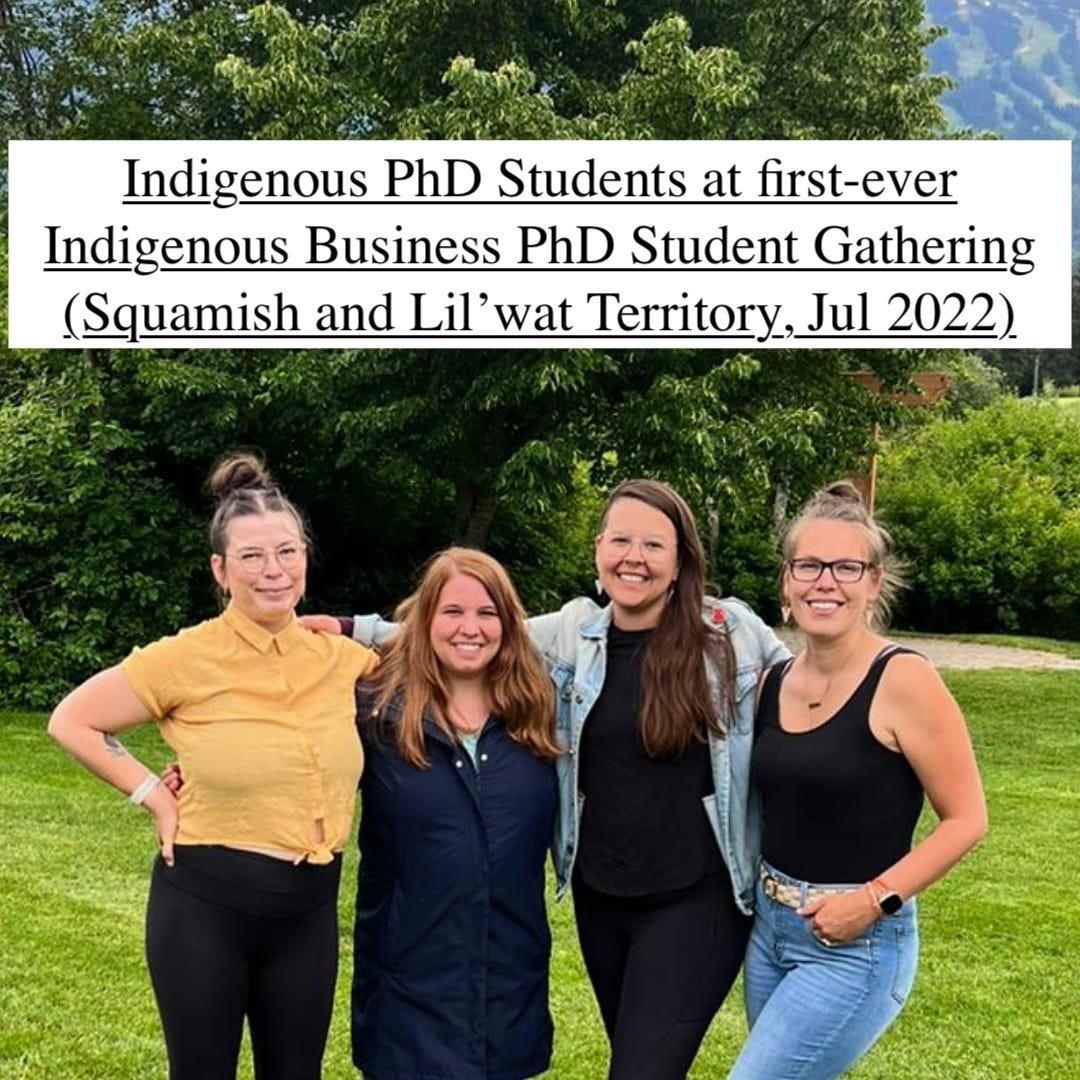
Co-Lead, National Indigenous Business PhD Student Gathering (Summer 2022)
Collaborated to finance, coordinate, and schedule the first ever National Indigenous Business PhD Student Gathering in Canada.
Secured partnership with Beedie’s Indigenous Business Leadership EMBA Program to hold gathering in July 2022 in Squamish and Lil’wat Territory.
Facilitates regular meetings among National Indigenous Business PhD group
Organizer, Indigenous Research Showcase Centre for Social Impact, Smith School of Business (April 2019)
Organized and co-ordinated research event to highlight ongoing work by Indigenous scholars around Queen’s University.
Co-Organizer, Reconciliation on Bay Street – Indigenous Business and Law Student Conference, Queen’s University (February 2019)
Organized and co-ordinated conference open to all Indigenous and non-Indigenous business and law students at Queen’s University.
Invited in expert speakers and panelists, whose work highlights the importance of economic reconciliation in Canada.
Reviewer, Academy of Management Annual Conference (2018 – 2021)

“We come to this project from a framing of Indigenous abundance, recognizing the innovativeness, strong community values, and passion of young Indigenous entrepreneurs in Canada today. We came to this project not to ask “What do Indigenous entrepreneurs lack?” or “What do they need to catch up?”. Rather, we sought to understand what motivates them to build their businesses and what they perceive to be their strengths as entrepreneurs.”
Excerpt from 2023 NACCA Report: Indigenous Youth Entrepreneurship in Canada